

I have been emailing author Clare London for a few weeks about a new anthology appropriately called Tea and Crumpet, which is a celebration of “Britishness.” This collection of short stories published by UK Mat was released July 3rd by JMS Books and is a celebration of what it means to be queer in Britain past and present. I asked Clare if some of the writers involved in the project would agree to be interviewed about the anthology and the idea behind it. After much arm twisting a few adventurous souls decided to talk, on condition that I serve tea and crumpets 😕 when we met for the interview. What? No coffee and doughnuts? 😯
Here’s my chat with Alex Beecroft, Charlie Cochrane, Clare London, J.L. (Jamie) Merrow and Josephine Myles. I tried to replicate all the colours of the rainbow flag for the text but WordPress has many limitations, including colour.
*********
What’s Tea and Crumpet all about?
Alex: After the m/m writers meetup last year, we realized just how many of us there are in the UK and Europe. When we decided to put together an anthology with stories from everyone who was attending the meet this year, it seemed obvious to have a theme of Britishness. We’ve all had so many years of watching everyone we know across the pond go to conventions and the big RT do, while we’ve had to look on and think “oh, I wish I could afford to go and meet all those other fans of the genre.” Now that we’ve got a con we can go to in our own country, it seemed right to start by celebrating our own country for a change.
Jamie: Tea & Crumpet is about cricket matches and country villages. It’s about fish and chips and chilly days by the seaside. It’s about the class divide, and the multicultural society. It’s about several countries, each with their distinct identity, all rolled into one kingdom. It’s about the wealth of history we share, and our rich folklore and traditions. Most of all, it’s about being queer, British and proud!
Where did you get that Tea & Crumpet name?
Clare: Watch how they all take credit for this *wink*.
Charlie: I suspect I may have been responsible for the crumpet bit. I was probably thinking about Jamie Bamber (who is often referred to in fandom as “the crumpet”) at the time. I often think about Jamie Bamber. *g*
Jo: Oh, there’s nothing like a bit of crumpet for afternoon tea. Yum.
Jamie: We had a bit of a brainstorming session, where all kinds of ideas were thrown out. I think I may have been the one to put tea and crumpet together, but with these kinds of things, it’s always hard to tell who came up with what!
How did you persuade all those great writers to join in?
Charlie: The offer of endless supplies of jelly babies and the threat of a big stick. Seriously, we were amazed at the generosity of authors; everyone bought into the project right from the start and could see what a potentially effective way of “getting our names out there” this could turn out to be. What’s particularly pleased me is that some of the best stories for the two projects have come from previously unpublished authors. There’s a lot of talent out there!
Jo: A combination of threats and bribery! Seriously, I was amazed and extremely grateful that so many talented and popular writers submitted stories, especially as we couldn’t offer any kind of remuneration and I’ve never edited an anthology before. I’m profoundly grateful to Charlie, Alex, Clare and Jamie for offering to help with the acquisitions and editing, so that my crazy little idea could become a reality.
What was it like being in the acquisitions role rather than the more usual submissions role?
Jo: A very steep learning curve, but an awful lot of fun. I think my favourite moments were reading stories from first time authors and discovering some absolute gems. That gave me a real buzz. It was also rewarding to be able to work on editing stories to help bring out their full potential. And best of all, I’ve made some new friendships with other authors and I’m really looking forward to meeting them all in person at the Meet 🙂
Alex: Very interesting! Charlie and I had had some experience of that before when we put together the I Do anthologies, all proceeds of which go to supporting the fight for marriage equality in the US. (Just thought I’d get a little plug in for those at this auspicious time 😉 ) It’s made me even more aware of how important it is to scrupulously follow submissions guidelines, and make sure your story is as spell-checked and proof read as you can before you send it.
Clare: And many, many thanks to JM Snyder for stepping into the role of publisher and helping us with so much of the organisation and logistics. She’s also ensured we get the book out in time to be available at the Meet itself. It’s been great working with her.
Why the British theme?
Jo: To be honest, for me that was the whole point of this exercise. I was flabbergasted when I started to realise how many US-set m/m stories were written by Brits. I kept hearing that this was what the publishers wanted and what sold, but I couldn’t help wondering if those writers had ever tried writing British-set stories, or if it was one of those myths that everyone accepted as truth.
It’s not that I want to criticise any Brits for writing US-set stories if that’s what they enjoy, but I hope that more British writers in future might question the assumption that they have to. I love our British slang and eccentric figures of speech. We have a beautiful country filled with fascinating characters, and I hope more m/m romance writers will consider telling stories using their British voice. I like to think that American readers have the curiosity and open-mindedness to embrace fiction from all over the world, and can put up with the odd bit of Brit slang – it’s usually easy enough to figure out the meaning in context.
Jamie: National pride—all right, any kind of pride (not to be confused with Pride, which is a whole other skillet of skate)—is rather frowned upon if you’re British. Self-deprecation is more the name of the game, don’t y’know. So this is us breaking through centuries of cultural conditioning, holding our heads—and our rainbow brollies—high, and shouting out loud we’re proud to be British!
After which, of course, we will apologise profusely for disturbing you…
Clare: And, of course, we have the best swear words by far … LOL.
What was the most different thing about writing in Brit-speak?
Charlie: For a relatively small country, we have a huge range of dialects, accents and argots. Go fifty miles up the road – if that – and all sorts of vocabulary changes. Clearly this can lead to all sorts of misunderstandings and if you take a further step it gets better yet. The UK understanding of the word “fanny” or the expression “being pissed” is not the same as it would be across the Atlantic.
 Alex: The best thing is being able to write naturally, without having to constantly police yourself and ask “will my readers understand this phrase?” Knowing that
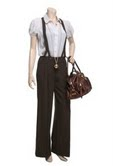 if I write “he wore suspenders and dark pants to go to the nightclub,” everyone will picture this
rather than this 
The stories were selected by a team of five – was it hard for you all to agree on any of them?
Jo: It was surprisingly easy, as we worked with the philosophy that we would work to get all stories up to scratch with careful editing, rather than rejecting stories. In the end there were only two stories we turned down, and I’m pleased to say that we accepted alternative stories from both those authors. In both instances it wasn’t a case of the stories being poorly written, but rather that one didn’t fit the theme sufficiently, and the other had a novella’s worth of plot crammed into a short story. Next year we’ll make sure the submissions guidelines are clearer!
Alex: We were actually pretty much agreed on everything, except for the occasional technical point. Although we each had different favourites, the overall quality of the stories was easy enough to see.
Clare: What I loved as I saw each submission enter the fray was the amazing range of styles and subject matter. I loved the way the theme didn’t restrict anyone too much – I think it’s brought richness and diversity to the anthology that you may not get with other books. There really is a Story for All Seasons – which, judging by the British weather, is what we need :).
Who came up with the eye-catching cover?
Clare: That would be the multi-talented Alex Beecroft! We all had some fun scouring through photo sites, but Alex found the teapot. She worked with JM Snyder at JMS Books to create a proper LGBTQ colour scheme, and we were all set. She created the British Flash cover as well, of course!
Here’s the blurb for the anthology
Raise your rainbow umbrellas high and celebrate!
Enjoy this enchanting, entertaining and thought-provoking collection, a heartfelt expression of what it means to be queer in Britain, past and present. All these stories reflect the iconic sights and national character of the British Isles: a taste of our idiosyncrasies and eccentricities, but also an unashamed representation of the love, loyalty and laughter of our people.Including a wide range of style and subject, this is the perfect way to sample different authors and to find both existing and new favourites. Follow the British way of life from historic villages to modern cities, from the countryside to the sea, through history and with a fantasy twist, in gardens, churches, campus and the familiar, much-loved local pub.
The stories cover universal themes of romance, desire, remembrance and reconciliation. The authors range from multi-published to up-and-coming, and they all share a passion for their characters, whether through great drama, erotic excitement, humour – or a combination of all three!
Edited by: UK MAT (UK Meet Acquisitions Team).
This anthology is a souvenir of the 2011 UK Meet, an occasion for GLBTQ supporters to get together in a relaxed setting to celebrate and chat about the fiction community they love. Funds from the sale of this anthology will go towards future UK Meets, to which all are welcome. Please visit the website for details.
www.ukmeet.weebly.com/
Please note that this anthology contains a few stories that are not M/M.
The Team is donating a free copy of Tea and Crumpet to a commenter on the interview.
And a REMINDER that for another FREE taster of British-themed fiction, download the flash fiction anthology British Flash at Smashwords today:










Love the teapot: want one.
Book too, of course.
I want one of those teapots too! I already have a beautiful rainbow mug, which reminds me, time for a cuppa 😀
I really hope publishers are not telling writers they prefer stories set in the US. Life would be so boring if everything were the same. As a reader from the US, I love to read stories set in Britain or Europe or the US or anywhere else in the world – I just want lots and lots of good stories! 😀
I’m looking forward to reading this anthology. Maybe it will start a trend. 🙂
So glad to hear that you like reading stories set over here. We promise to keep writing them!
*nod*
Carina Press encouraged me to keep my British spelling too. I’m committed to my U’s in colour, flavour etc 🙂 (although hubby tells me that’s from the French anyway …).
Kiracee, I can’t speak for other publishers, but Samhain Publishing in particular seem very open to non-US-set stories. I’ve just been doing edits for my second novel, Wight Mischief, which is set in England – and so far, I’ve even been able to keep the British spellings! 😀
Glad to hear you like a bit of variety in your settings.
Jamie
In your most recent novel from Samhain Muscling Through (which I love BTW) the spelling is entirely British which was appropriate because of the setting. To change it to US spelling would have screwed up the story which would not have had the same impact.
Hi Kiracee,
I’ve certainly never heard writers say that publishers have turned down stories because they are set in the UK, but I know that many have had problems with publishers refusing to accept that certain British phrases can be understood by the rest of the world! Most of us are used to having to change our spelling and grammar (Samhain being a notable exception) and carefully police our use of certain terms like pants, vests and suspenders, as Alex pointed out 😉
I hope you enjoy the anthology – a whole lot of love went into it 😀
I’ve not had a story turned down but I have had a few heated discussions over the need to use UK spelling, which I think is particularly important in an historical story. Luckily I have managed to persuade editors in the past, and with my latest historical I queried the acceptance of UK spelling before I would submit, and happily it was no problem. Perhaps the times they are a changing?
As one of the ‘never published before’ contributors, I was a bit nervous about the whole process, but the MAT team did a fantastic job during the whole editing process of putting up with my own self-deprecatory comments and giving helpful guidance. I think this shows with the anthology. It’s packed with brilliant stories, all of them with a unique British flavour, and I’d highly recommend it.
well done to everyone involved!
Thanks, Jenre. We were delighted to have your story.
And thanks, Wave, for hosting us!
I’d second that, Charlie!
It was fantastic to work with the new British talent! 🙂
We loved your story, Jen – thank you so much for sending it in. I KNOW how scary that first time submission is, but I’m glad to hear we made it as painless as possible 😀
Hurrah for Jen’s launch into publication! And such a marvellous story, too :).
As a life long tea drinker I would like to be counted in for the freebie. 😀
Hooray for tea drinkers!
Now you’ve got me trying to remember how much tea drinking actually goes on in the stories…
Great interview, Wave. I’ve just finished reading this anthology, and enjoyed it very much. As an Aussie brought up on British stories, I loved the British theme. I hope to see more stories from these writers in the near future.
Glad you enjoyed it, Gaycrow!
Actually, I wonder why there aren’t more Australian-set m/m stories? What with all the warm weather encouraging the taking off of shirts… 😉
In Dash and Dingo by Sean Kennedy and Catt Ford, which was set in Britain and Oz in the ’30s, the spelling was American which spoiled the story for me and I commented about it in my review. I wish publishers would realize how much the authenticity of stories is negatively affected by the spelling.
This happens all the time with Australian set stories – jelly turned into jello; stream substituted for Aussie creek, slang disappeared and so on. Keri Arthur’s Riley Jenson books are one example of this (they are mainstream m/f UF).
But then there is the other extreme where we are caricatures of ourselves. Crocodile Hunter has a lot to answer for.
If I can cope with purely American words like ‘copacetic’ and work out that ‘lucked out’ means lucky not missed out and enjoy the foreignisms of the language as part of the story I don’t understand why it isn’t accepted the other way. So it is good to here that there is a loosening of the hegemony of American English.
This is so true. I was reading a forum the other day when someone mentioned that using metric measurements rather than U.S. measurements threw them out of the story.
I can’t see the problem – even if one comes across terms that are unfamiliar, the meaning can often be deduced from context, and if not it’s easy enough to look something up. Like you, I enjoy different slang of different countries.
So happy you enjoyed it, Gaycrow! And I’d love to read more Aussie stories too – you guys down under have fantastic slang 😀
Lovely interview with our fabulous team 🙂
I thoroughly enjoyed contributing to both British Flash and Tea and Crumpet. It was really difficult, funnily enough, to lose the Americanisms – and it was my first attempt at writing a story within such a short word count.
Jo and the girls were fabulous to work with and kept everything ticking along and I’m so glad that so many people are enjoying it.
Can’t wait to see you all in a few weeks 🙂
Jo (Josephine Myles) deserves a medal – without her none of this would have happened! It was her initial idea to do the anthologies – and she kept us all very well co-ordinated throughout the process. 😀
Definitely! It took a really well organized and energetic leader to get two anthologies done in so short a time with no meltdowns or angst, and Jo was that person 🙂
LOL – you just didn’t get to see the angst and meltdowns – I kept them very private 😆
You were all wonderful to work with – any meltdowns were strictly related to formatting British Flash for Smashwords! And thanks for saying such lovely things :blush:
All very well deserved! We worked very well as a team, but we needed Jo to keep us coherent :).
Oh, hear hear.
Actually, we gelled really well together as a team – all had very similar opinions on the stories, which we saw ‘blind’, ie without knowing the authors.
Thanks for having us, Wave 🙂 If you’re not sure what crumpets are, they look like this
http://i186.photobucket.com/albums/x163/Wulfwaru/crumpets.jpg
served piping hot, with the butter melting in and dripping down your fingers 🙂
(And “crumpet” is also used as slang for anyone who is deliciously sexy.)
And for those who’d like a little more guidance on crumpets, there is a lovely video here: http://www.youtube.com/watch?v=HN_ZYjS7ao0
Quintessentially British – especially the bit at the end! 😉
(We’ll gloss over the sacrilege committed of suggesting margarine as an alternative to butter!)
Thanks for inviting us over, Wave. The tea and crumpets were most civilised. Not that I don’t enjoy a coffee now and again – but you can keep your doughnuts! 😆
You can tell your publisher(s) that we do want British stories from British writers (well I do anyway) 😉
And I want that teapot + cup 😀
Very much looking forward to reading this
Yay! That’s great to hear 😀
Thanks Idamus – I hope you enjoy it. And yeah, I want the teapot too. I already have a similar mug. Mind you, one can never have too many mugs 🙂
Sorry, Jo, I have to disagree with you there. It is possible to have too many mugs. The definition is “more than you can store in the cupboards + the washing up pile + the draining board + all the boxes in the ‘spare’ rooms” 😀 You can substitute “dishwasher” for “draining board” (or add it as an extra storage place!) if you like, but that just gives you a higher limit…
Hehe, I always end up breaking them before I end up getting too many. My husband says I’m just trying to get out of doing the washing up!
What a great interview – and well done on the colours, Wave! It really was great to be involved with this project (both anthologies, that is) and I am really looking forward to meeting everyone face to face. This will be my first attendance as I couldn’t manage to get to last year’s meet.
So many authors I love and from half of them I didn’t even know they are British :blush:
Since I’ve been reprimanded often enough by my American penfriend for my “briticisms”, I’m looking forward to reading an entire anthology where I can get them in spades, along with great stories!
Feliz, that’s a lovely compliment to pay the authors – that you love the work and only worry about the author’s status second :). Though I’m hoping it’s not because we’ve all been shoe-horned into the generic template *sigh*.
I work with a girl from LA and we both agree we’ve become “honorary” nationals of each other’s country by now LOL.
Great interview, Wave and I love the colours.
I enjoyed being part of the project even though it took me a long time to write my contributions. I am so used to removing British words and phrasing that it was difficult to write in ‘real’ English. 😀 The great editing team caught a few slips into US slang rather than UK so my stories should be properly British.
I think publishers like ‘exotic’ stories set in the UK (or anywhere in Europe), but want US spelling and phrasing to match house style or make it easier for US readers to follow. It is very difficult to write a British story that way, at least for me, because it doesn’t sound British anymore.
I love the cover and I want my own teapot and mug too. Maybe that could be another fund raiser? 😀
Well, yes……I think this is an intriguing and (to me) inexplicable approach. I’m sure it’s insulting to many readers if publishers feel they have to “force” the book’s language into some kind of generic standard, in fear of confusing readers. After all, *I’ve* managed to master US-speak over the years LOL, so I’m sure most people could and can master Brit-speak :). So I assume the real reason is so publishers and their edit team find it easier to proof the manuscript to the same US-based reference.
Plus the different national flavours offer an even better choice of fiction for the lucky reader! 🙂
I think you may have hit the nail on the head there; it’s easier.
It’s also a challenge to persuade people to let your characters speak (as people often do) ungrammatically!
I’ve read a couple of books where the characters spoke ‘naturally’ but that doesn’t always work in print. Half sentences and interruptions with plenty of fillers (‘er’ and ‘you know’) convey speech patterns without much information. 😀
But it is very difficult to accept changes to my character’s voice and phrasing that don’t match what I hear in my head.
I think that most US readers have enough brain capacity to pick up Brit lingo if given the chance. Like you I had to learn US stuff. I even tried oreos when they appeared over here – I’ll stick to custard cremes and bourbon biscuits!
Hmmm yes. I’m afraid I tried Oreos once but didn’t return :). And I always carry British chocolate with me when I go over to the US! I can happily do an exchange with their Pocky…
Fab interview there. I loved being part of the two anthologies and getting the chance to experiment a little in both subject matter and style.
Stevie, your stories were a refreshing delight! And you’re right, it gave all of us a chance to offer up something a little out of the ordinary – if we wanted. This project has been a real opportunity to find new friends and authors :).
Aww, thanks for that!
I’ve never seen a better illustration of US/UK English differences. XD
As a European, I get tired of nameless-US-city theme, so it’s a delight to read something different both from already published (and a few of my favorite) and new authors. Once I have the anthology, I’ll jump right on Jenre’s story though. 😉 This is a great way to introduce the new authors. I’m not a big fan of tea (although that teapot is fabulous), but I’ll never, ever say no to any cake. 🙂
Looking forward to this book.
There’s so much good stuff in this anthology. It’s a brilliant book to dip into with stories to suit every mood or situation. I’ve thoroughly enjoyed reading the tales and am looking forward to having a print copy to lug around and dog ear and make it look loved.
My contributions to “T and C” and British Flash are my first attempts at stories, and I don’t think the editorial experience could have been made more comforting and reassuring, especially for such a complete novice. And what company to be in! Thank you so much, ladies.
Great cover, wounderful project, I’m looking forward to reading it!
Now you’vegot me yearning for I a good cup of tea. It so hard to find here in the States, Lipton doesn’t make the grade. Is there good tea in Canada? 😕 I’ll be traveling to Whistler for vacation maybe I can find some there! :crystalball2:
Great Post. Thanks for all your support of the site here at Wave’s :wave:
I have already started on British Flash and I’m looking forward to T and C. I love themed anthologies and have an abiding love for things British that dates to the days I began reading Georgette Heyer and Harlequin medical novels.
Tried to comment earlier from my phone, but it didn’t seem to work.
That was a fab interview, and I really enjoyed writing for both anthologies, although only one of my stories was strictly m/m.
As an American who lived in Australia for a few of her formative years, I go back and forth between American and British spelling of words. One thing I miss? Aussie slang and curse words. Good ‘ol American slang sometimes just doesn’t cover the situation! 😀
Great idea. I look forward to reading this!
PS Can anyone get me some crumpets? The grocery stores here don’t sell them anymore. 🙁
How about a recipe from the Hairy Bikers?: http://www.youtube.com/watch?v=t639VluKVAA. It was near the crumpet video linked to by JL Merrow, above 🙂
Lasha, the slang is one of the places I find the most difference, especially the cursing LOL. British-English has a marvellous range of options *hehe*.
*makes a note to fill my suitcase with crumpets when I next visit the US*
Ditto on more British stories from British authors and spelling definitely counts! Can’t wait to read these
Great interview. I love it when M/M books really have a sense of place and I think the scope for such settings is huge in the UK, with our persistent individualism or stroppiness. In Yorkshire alone there is a significant difference 25 miles down road.
I wish I could meet you guys at Milton Keynes,- but I can’t- hope you have a great time.
I can’t wait to read this anthology. I’ve downloaded British Flash too. As for publishers who won’t accept real British words in British set stories 😕 How silly is that!
I loved British Flash (Mara’s rook shifter was priceless) and I’m half way through T&C – which is also excellent.
I’ve commented before on here how lovely it is to read a British book – there do seem to have been more around in the past year. As I read, I realise that I am just that bit more relaxed – probably because I get the jokes more easily. It is refreshing to hear other voices, nationally speaking – I really enjoyed Jayne DeMarco’s Cooper’s Crossing earlier this year. Not only was that set in Australia, but also in another time frame – 1950s or 60s if I remember correctly.
Really looking forward to meeting people at MK on 23rd.
Glad you liked the rook. I suspect he needs a picture for non-Brit readers, but as I’ve had to look up US and antipodean birds… 😀
Interesting interview!
It never occurred to me that publishers would reject stories just because they aren’t set in the US. There are a lot more (gay) stories set in the US than the UK, but I just always thought that’s because there are that much more writers in the US..
Also interesting to hear how this anthology was thought-up and created. It sounds like an awful lot of work..
And the cover and title couldn’t be more perfectly fitting!
I’m definitely interested in this anthology, seeing some of my favourite authors among the contributors and some authors I haven’t read so far.
Esther
I don’t think publishers reject stories set in other countries, but they make the authors use US spelling regardless of where the book is set to comply with their “house style.”
To be fair, Wave, it works the other way around as well. British publlishers insist on British spelling, even for stories set in the US or Canada. That is their ‘house style’. Very few publishers (I am aware of only two) leave the choice to the author. One of them ‘warns’ readers at the beginning of the book as to which type of English is bing used. Now, THAT, I think, makes sense. 🙂
Serena
I don’t read enough books released by Total-e-Bound and other Brit. publishers to notice this but probably that’s because I use mostly British spelling. I believe that Carina and Samhain allow for different spelling depending on where the book is set, and I’ve seen books released by Amber Allure with British spelling. However, some publishers are inflexible which is too bad because then the authenticity of the characters comes into question, for me anyway. 🙁 I’m still mad about Dash and Dingo almost 2 years after it was released. lol.
I know! I totally agree!!!
Fun interview, and I look forward to the anthology! Alex, LOVED your illustrations of suspenders and pants. “Jumper” as used by British writers also used to puzzle me. As a girl (decades ago), I wore jumpers that were sleeveless dresses meant to be worn over a blouse. 🙂
Running into words used in unfamiliar ways adds to the fun and verisimilitude for me. Reading books by authors from different cultural backgrounds can be a kind of armchair traveling, one of the pleasures of reading. It can sometimes be a bit distracting, but then I get to tell myself that this is educational reading, not trashy at all. 😉
Clothes are certainly an area that’s full of pitfalls. I think the garment you’re describing would be called a pinafore dress over here, and a jumper is a sweater (I think.) I always get confused with vests as well, because what you call a vest, we call a waistcoat, and what we call a vest, you call an undershirt (I think). It all can certainly call up some very strange mental pictures if you get it wrong 🙂
And yes, I think it’s great to be able to have a window into different cultures through romance. I’d like to see more of it. I’m sure we’ve got writers from all over the world in the genre.
Loved this interview. As a US high school student, I spent a month with an English family & was introduced to the whole “pants-means-underwear” british-ism. (I snickered every time the lady of the house insisted on ironing my “pants.”) I think it does add to the flavor of a story to use the slang & spelling that suits the setting, and that makes it all the more interesting and authentic for readers. Definitely will read this one. Thanks.
This is definitely going on my to-buy list! Many of my favorite authors (and most I knew were Brits!) I’m looking forward to reading the stories and maybe one of these days, I’ll be able to make it across the ‘pond’ to attend a meet!
Merith, if you ever make it over here *hugs* we’ll have a Festival of Fun in return for the years when I visited with you in SF :).
I love seeing the British slang in books. I was raised by an Irish mother so I grew up with Irish slang at home and my everday American slang. Apparently I was drinking tea with milk and sugar from the bottle as a child.
Thanks for this. I am looking forward to some more British stories and hopefully some Irish ones too.
Love the cover of the book – I’d love to have that tea set 😀
Thanks for such a great chat – it was definitely interesting reading everyone’s thoughts and answers.
Great and informative interview Wave! I love the different colours and I agree with Jo that there needs to be more British-set books, with British spelling and slang! It’s not that hard to understand a bit of slang 😆 Looking forward to reviewing the anthology!
I really hope you like the stories Leslie and I may have another Brit novella for you to review in about a month or so. 🙂